


In This Guide
Why all the experts say hire a driver instead of renting a car.
What a distillery tour actually costs.
How to reach craft distilleries that publish no tour information at all (which is most of them).
How much tequila you can realistically carry home from Jalisco.
Best bets for restaurants, hotels, bars in the key areas.
There is a version of this trip that goes badly.
You land in Guadalajara. You rent a car. You book four distilleries for Tuesday, two in the town of Tequila and two in Arandas, because they looked close together on a map.
By two in the afternoon you have had eleven pours. You are an hour behind. You are driving. And the small producer you actually came for isn’t open, because you never confirmed the tour.
We surveyed The Tequila Report reviews panel to help you do better.
Among the twelve members of our reviews team that participated in this guide, we’ve collectively visited more than 50 different distilleries. I’ve done 30 myself.
Here’s all you need to know about having a great trip to tequila country.
And if you want to come with us, our next trip is October 13-16.
Where is tequila actually made, and which region should you visit?
Tequila can legally be made in only 181 municipalities across five Mexican states. Jalisco, Michoacán, Guanajuato, Nayarit, and Tamaulipas. Almost everything you care about is in Jalisco.
And Jalisco splits into two corridors that behave nothing alike. For a first trip there are really two choices: the area near the town of Tequila, an hour northwest of Guadalajara, or the Los Altos Highlands an hour or so to the east of Guadalajara.

The Valley is west of Guadalajara. The Highlands are east of Guadalajara.
Los Valles (The Valley) is the original tequila-making region and includes the towns of El Arenal, Amatitán, and the small city of Tequila itself. It is very compact. The distilleries sit close to each other and in Tequila, are close to walkable hotels and bars.
The town of Tequila has been a Pueblo Mágico since 2003. The surrounding agave landscape has been a UNESCO World Heritage site since July 2006. It is VERY charming.
Los Altos is the highlands to the east. Atotonilco el Alto, Arandas, and Jesús María are the main tequila-making towns. Higher elevation, red volcanic soil, and longer distances between stops. More scenic, more rural. Also quite a bit milder temperatures, due to altitude.
Los Valles is perhaps the best first-time trip. Everything is closer, more of it is built for visitors, there are more (and better) hotel options, and you’ll spend less time in a vehicle.
Which airport should you fly into?
Fly into Guadalajara (GDL). It is the only airport that puts both corridors within reach in one trip.
Guadalajara's airport sits southeast of the city on the Chapala highway. From there to the town of Tequila is roughly 75 minutes.
Guadalajara is the second-largest city in Mexico, with a population of nearly six million. Consequently, the airport is large and modern. They even have two Shake Shacks.
You can do a trip to The Valley from Puerto Vallarta (PVR), especially because the new toll highway is now open. It's about a three hour drive, depending upon where in the Puerto Vallarta area you leave from. The trade-off for that speed is the highway toll is 1,300 pesos each way, roughly the cost of an airplane ticket.
The flight from Puerto Vallarta to Guadalajara is 30 minutes on domestic Mexican airlines. I live in Puerto Vallarta half the year, so I often will fly into Puerto Vallarta to spend a few days at my home there, then do the quick flight to Guadalajara to start a tequila trip, rather than mess with a three hour car ride each way.

The Tequila Report co-founders in central Arandas
How many days do you need to visit tequila distilleries, and when should you go?
Give yourself enough days to treat Los Valles and Los Altos as separate trips. It's doable to make a combination trip, but it's a lot of driving and can be pretty exhausting. I don't recommend it for first- or even second-time visitors to tequila country.
"Break the valley and the highlands into two different planned trips," reviewer Greg Bartolotta recommends.
Your trip itinerary is governed by two rules our panel agreed on completely. No more than two full distillery visits each day. And never the Valley in the morning and the Highlands in the afternoon, or the reverse.
If you only have a long weekend, pick one corridor and do it properly. Probably the Valley if it’s your first tequila adventure.
Usually, our trips are three or four nights, which includes two or three days of distillery visits. You can go longer than that, but it all can become a bit of a blur. I recommend two, three-day trips rather than one, five-day trip if you have the option.
I've visited tequila country almost every month of the year. I think the best times to go are spring and fall, February through April and September through November.
On climate, summers, especially in the Valley, can be quite hot indeed. Also, July through October is rainy season, and that name is very much earned.
Most distilleries stop producing after about December 10th each year because the Mexican holiday season is quite extensive, and distilleries use that stretch to do annual deep cleaning. Also, be mindful about trips near Easter, as the “Mexican spring break”, Semana Santa, will find the region chock full of Mexican nationals on holiday, making hotel availability a dice roll.
Throughout the country, the Mexican work week is Monday through Saturday. Nearly all craft distilleries will be closed on Sunday. A few of the big ones may be open. This is why we often schedule tours where guests arrive or depart on a Sunday.
Should you drive, hire a driver, or book a group tour?
This is critical. As reviewer Christine Hansen said, "Choosing the wrong tour guide or wrong transportation can break a trip."
Hire a driver, or book a tour. (With us, or with a different group)
Every one of our reviewers said the same. Nobody suggested driving yourself. First, you’re drinking tequila. Second, Mexican traffic and way-finding can be complex.
"Secure a driver that is familiar with distillery tours," reviewer Mike Barad said. "Don't rely on Uber/ride-share."
Bartolotta concurs. "Hire an experienced bilingual driver. Money well spent."
Reviewer Heidi Anderson underscored the advantage of a driver at night. "Navigating around can be challenging, and especially in the evening, it's not always the easiest place to find your way around."
There are many qualified drivers that would be delighted to show you the joys of tequila country. Two that I personally recommend are:
Ramon Arzolo Gonzalez. +52 33 1313 1758 on WhatsApp (you should download WhatsApp for Mexico. It’s universally used for phone/text).
Francisco Castillon. Find him as @better_call_pancho on Instagram.
In addition to private drivers, you can join a small group tour. This is a fantastic way to experience all things tequila, as these companies have a ton of experience, offer behind-the-scenes access not available to all visitors, and package distillery visits with great restaurants, cultural experiences, insurance, and more.

We work with PKGD Tours, who run 10-person tours (some of them guided by me) multiple times each year, to both the Valley and the Highlands. Our next adventure includes the Highlands plus a very special visit to the Sierra Mountains to see raicilla production and stay in a 1600s family-owned hacienda.
Other good tour options include Experience Agave, and Casa Colectiva.
Which tequila distilleries offer tours, and which ones can't you visit?
In general, the tours/visitors infrastructure in Jalisco is not as developed as you might expect. The big, well-known places (Cuervo, et al) run scheduled public tours you can book online. This is similar to a winery tour in Napa or Sonoma.
Nearly every smaller, craft distillery is by appointment only. And a few famous names like Don Julio do not regularly accept visitors at all.

Tour of El Llano distillery in Tequila, where Arette is made
These places (perhaps not an exhaustive list) do have public tours and take reservations. Fees vary, but average 500-900 pesos per person.
The smaller distilleries:
Atanasio, at the Familia Landeros distillery outside of Tequila. They offer jornalero and agavero experiences, where you see what it takes to plant/harvest agave. For me, this is a must-do tour, and is the ideal first experience.
El Tequileño, the La Guarreña distillery in Tequila
Fortaleza, the Los Abuelos distillery in Tequila (The brand is known as Fortaleza in the U.S. and Los Abuelos elsewhere)
Cava de Oro, the Tequilera Puerta de Hierro distillery in El Arenal
Cazcanes, the Tequilera Tap distillery in Amatitán
Tequila Ocho, the Los Alambiques distillery in Arandas
The bigger distilleries:
Mundo Cuervo, the La Rojeña distillery in the town of Tequila
Casa Sauza in Tequila
Casa Herradura in Amatitán
For the other 190+ distilleries, you’re unlikely to find a tours webpage or online calendar.
The way in is a direct message on WhatsApp or Instagram. A polite DM to the account often gets better results than a website contact us form submission. Write in Spanish if you can. Ask for a specific date and say how many people are coming. If you need the tour in English, make sure to mention that.
The alternative to this DIY approach is to let someone else do it.
A tour operator with existing relationships can open doors that a cold message cannot, particularly at producers who take visitors as a favor rather than as a business. Our tour partner PKGD Tours handles this, and it is the most common reason people book a guide rather than a driver.
Should you visit large or small distilleries?
The visitor experience at big distilleries is less personal and often less educational, but if you can, visit large and small, as it provides a fascinating juxtaposition between craft and commercial production scale.
"The big brands have easy to book tours but it will feel like you are on a limited factory tour," reviewer Bryce Taylor said. "It won't feel personal and they won't deviate from the script. The smaller brands are more personable and the tour is more intimate and they will allow you to experience more of the production process."
The smaller brands will spend more time answering questions, the group sizes are usually smaller, and you might even get to meet the maker or owner.
Where should a first-time visitor go?
Asked to name one tour for someone's first trip, reviewers most often named these six.

At the Familia Landeros distillery, near Tequila
Each is listed with its NOM number, the four digits that identify the registered producer.
Familia Landeros, makers of Atanasio and Valor, NOM 1599, in the Valley. "An amazing experience from field to bottle." (As mentioned above, this is my recommendation for your very first distillery tour)
Los Abuelos, makers of Fortaleza, NOM 1493, in the town of Tequila. "The property is beautiful, the tasting cave is unique, the small but traditional distillery is surprisingly small, the tequila is hard to find and you might get to purchase some Los Abuelos bottles."
Feliciano Vivanco and Associates, makers of Viva México and many craft brands, NOM 1414, in Arandas. "They are the most welcoming and fun." Another reviewer put it as "the family feel of the place. Not a distillery. La familia."
El Llano, makers of Arette, NOM 1109, in the town of Tequila. "Cleanest, most efficient for its size, the quality of the tour and tastings, and because it's in Tequila town."
Cascahuín, makers of their eponymous brand, and many others, NOM 1123, in El Arenal. "You can see multiple production techniques of cooking, extraction, fermentation, and distillation methods all in one place."
El Pandillo, makers of G4, Volans, and other craft tequilas, NOM 1579, in Jesús María, named for the singularity of its process and the brands behind it.
Other highly recommended stops include: El Viejito and Siete Leguas in Atotolnico el Alto, La Alteña and Los Alambiques in Arandas, and El Tequileño and La Tequileña in Tequila.
What do first-timer tequila visitors get wrong?
Most first-timer mistakes are logistical, not tequila-oriented.
They schedule too much in a day.
They don't eat. Three reviewers raised this unprompted. Taylor says, "Make sure you don't have an empty stomach." Hansen agrees. "Eat a good breakfast, bring snacks and water for the bus. Stay hydrated. And eat enough to absorb the tequila you'll sample." Anderson goes even further. "Be prepared with water, electrolytes, anti-nausea medication, and protein bars or snacks. Make sure you eat breakfast, lunch and dinner because you will be doing a lot of drinking. A lot."
They arrange the wrong transportation, or none at all.
They show up without a reservation. "Don't assume you can simply show up at any distillery and expect a tour," Anderson said.
They don't know the process yet. Reviewer Keith Bogart wished he had known more about the steps of tequila production so he could better appreciate what he was seeing. Read up before you go.
Not packing right. These are working distilleries, not a fancy winery tasting room. Barad notes that "most locals wear pants regardless of weather." Bring a hat, sunscreen, and comfortable, closed-toe shoes. There is a lot of walking.
How many distilleries can you realistically do in one day?
Two distilleries a day, maximum.
"Scheduling too many distillery tours on the same day is a mistake," Barad said. "Travel takes time and you don't want to rush a great experience or overindulge. Go for quality over quantity. Stop and smell the cooked agave."
Greg Bartolotta explains, "One fully immersed tour can take up most of your day."
Anderson added the buffer rule. "I recommend allowing at least a couple of hours between distillery tours because things tend to run on their own schedule, and chances are, at some point, you'll be running late."
How far apart are these places, really?
Farther than it looks on Google Maps. Guadalajara to the town of Tequila is about an hour. But traffic in the afternoon means the drive BACK from Tequila to Guadalajara can be two hours. Guadalajara to the far side of the Highlands is more than two hours, depending on route.
We made this map to help you plan based on Google's typical times for a 9 a.m. Thursday departure, but afternoon runs back into Guadalajara take longer. Verify all drive times on the day of your journey. Weather, traffic, road closures, can modify these times a lot.

What actually happens on a distillery tour?
Nearly every tour follows the same arc. You might see some agave fields, but usually just as scenery. Atanasio is the one that takes you into the fields.
Usually you’ll see the production process, in order.
Where the raw agave is brought for processing, and an explanation of how it is prepared
How the agave is cooked (oven, autoclave, or diffuser)
How the juice from the cooked agave is extracted (roller mill, screw mill, or tahona)
How that juice is then fermented, in what vessels, and the yeast used to convert sugar to alcohol
How the resulting mosto is distilled, in what vessels, and a discussion of first distillation (ordinario) and second distillation (tequila)
Aging room, barrels, and information about how the tequila rests
(sometimes) Bottling line, packaging, and shipping
Then, you get to taste! Usually five or so samples, moving from blanco to reposado to aged expressions. Especially at smaller distilleries, you may get to try unreleased projects or Mexico-only expressions.

A BIG tasting at Feliciano Vivanco and Associates, in Arandas
What varies from distillery-to-distillery is tour depth, guide knowledge, and how much of the process you get to see. Sometimes that’s dictated by the schedule of the day. Smaller distilleries don’t make batches every day.
Some of the most memorable tours deviate a bit from the script.
Hansen's most surprising visit was Familia Landeros, for "the tour of the agave fields, getting to dig up a hijuelo and jumping in the back of the workers' truck to have breakfast in the fields."
Anderson's was Caballito Cerrero (technically not a tequila producer), reached by a road she called "pretty treacherous and honestly a little scary at times." There is no tasting room. A lab serves the purpose. You can hear the water source from the property itself.
Bartolotta's was the Trujillo distillery in the Highlands, for an "up close look at a working diffuser and their double wheeled Roman tahona."
For me, it’s always carnitas and cocktails served at El Viejito.
What should you ask while you're there?
Ask about yeast.
Of all the questions our reviewers put to distillers, yeast came up most often. It is the fastest way to learn whether you are on a script or in a conversation.
A few good questions to consider:
"How do you select the yeast strain for your fermentation?" Or the sharper version: "How do you apply the yeast if not using wild/native yeast?" A third reviewer asks it as "What type of yeast is used for fermentation, and do you use a starter yeast?"
"Describe your distillation process. Define heads, tails, and hearts." Hansen asks the master distiller directly, if possible, and tries to sample as she learns.
"What experiments are you currently working on?" is Taylor's go-to question.
"What makes this brand different from the one in the next town over?"
"What's the story behind the brand's name?"
"Will we get to drink straight from the still?" This is Anderson’s key question, and she likes the odds. "The answer is usually yes. And I like that answer."
"Can I go swimming in the fermentation tank?" Bogart swears this one gets a good response!
Should you buy bottles at the distillery?
Probably, yes. The reason to buy at the distillery is access, not price.
If you want to get more out of the pour itself, our six-step guide to drinking good tequila covers what to do with the glass in front of you.
One piece of tasting-room advice, from PKGD Tours: the common mistake is trying to finish the contents of every pour. You do not have to. And if you do so, the second distillery visit of the day can get a little fuzzy.
Producers regularly pour bottles that are hard to find anywhere else, and sell them at the door.
So ask the direct question. “Are these the same tequilas I can get in the United States?” Sometimes the answer is no, which presents you with a rare opportunity. And even if the answer is yes, it’s nice to buy direct from the distillery because they make more money per bottle when you do.
Pricing is going to be roughly equivalent to what you’ll find in a good shop in the U.S. There aren’t huge discounts to be had on tequila purchased at distilleries or at tourist-focused agave spirits retailers in the region.
Most distilleries will take credit cards. But it’s always wise to have pesos, just in case.
How much tequila can you bring back to the US?
In practice, it’s about as much as you can carry.
Start with the rule, because it gets misquoted constantly. One liter per adult 21 or older comes home duty free as part of your $800 personal exemption. That is an allowance, not a limit.
Federal law sets no cap on personal-use quantities beyond it. CBP is explicit: "While federal regulations do not specify a limit on the amount of alcohol you may bring back beyond the personal exemption amount, unusual quantities may raise suspicions that you are importing the alcohol for other purposes, such as for resale."
So all bottles for “personal-use” are fine. As long as you aren’t bringing cases and cases back, the tequila won’t be seized. But, all bottles past the first one are technically subject to duties and taxes, and that’s at the discretion of whatever CBP officer you’re standing in front of at the time.
Also, state-by-state rules vary, and land crossings are treated differently than airports. But the practical reality for tequila travelers flying home with a reasonable number of bottles for personal use is that they clear the border with little friction, and duty often is not collected at all.
Don’t sweat it. It’ll be fine. Worst case scenario you’ll have to pay a few dollars per bottle in duties.
The real constraint is not the law. It is your luggage. Weight limits and checked-bag capacity stop more tequila at the airport than customs ever does. Each tequila bottle is approximately three pounds, and that weight adds up quick.
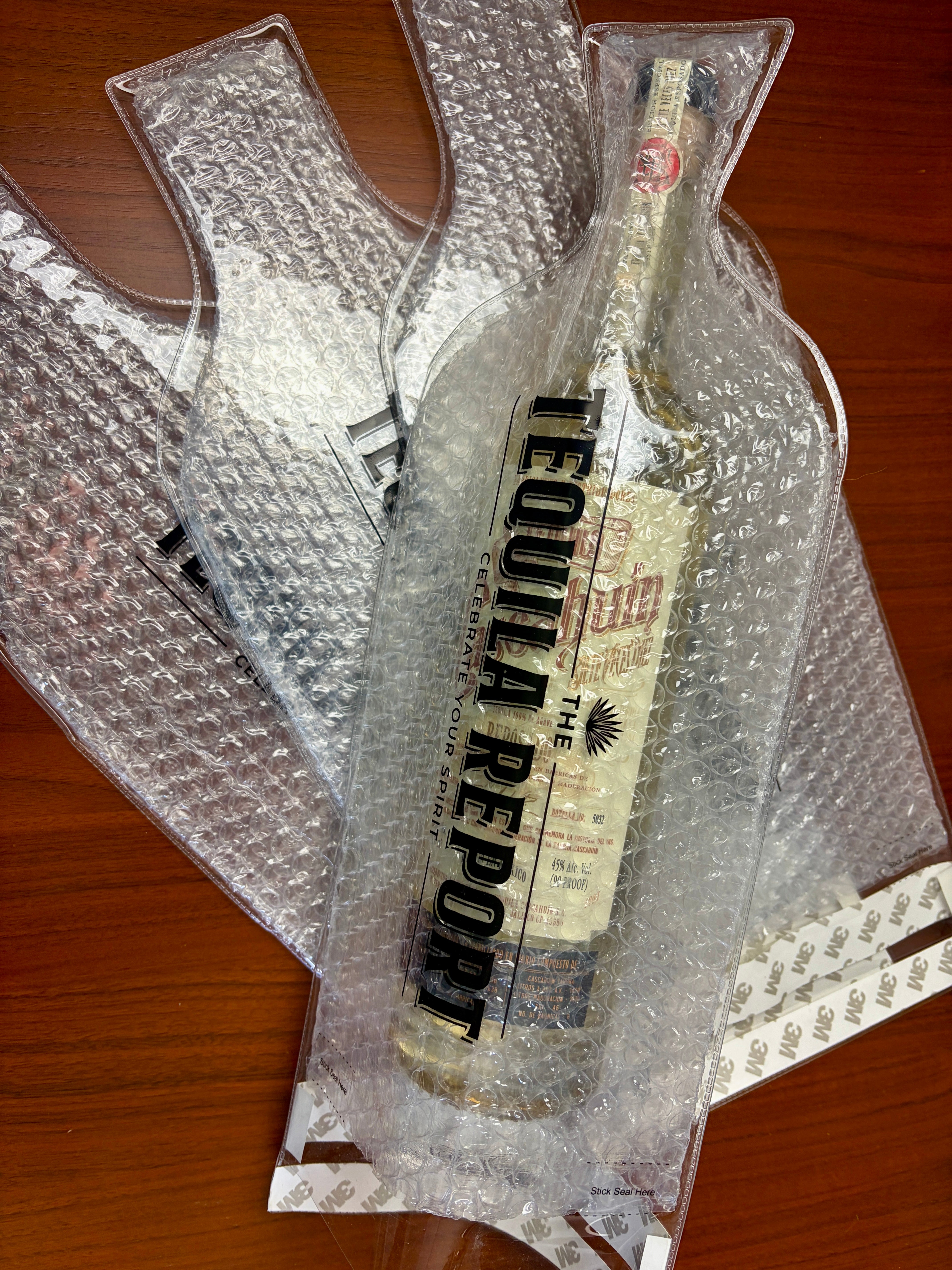
Before you go, invest in bubble wrap and bring it with you, as it’s not easy to find packing supplies once you’re in tequila country, and there are few things worse than a suitcase full of tequila and broken glass. The even better bet is to purchase and travel with sealable bottle bags. We sell them in our store.
Where should you eat, drink, and stay?
Hotels for Tequila Tours
The three places you’re likely to overnight are in Guadalajara, Tequila, and Arandas (the largest city in the Highlands region).
Options in Guadalajara:
Casa Habita and Hotel Demetria are boutique, design-forward hotels in the Lafayette/Colonia Americana neighborhood. If you prefer more familiar accommodations, or want to use points, the AC Hotel, Westin, and JW Marriott are all in the nearby Providencia neighborhood.
The ultra-charming Tlaquepaque neighborhood is extremely walkable and close to the airport. Two hotels there are very popular with tequila travelers: La Villa del Ensueño and Quinta Don Jose.
Options in Tequila:
Casa Salles is a lovely boutique option, and is run by the El Tequileño distillery. Casona 1530 is also a good bet for a nice stay. Solar de Las Ánimas is the very best location, right on the lively Tequila town square. It’s swanky, and owned by the Cuervo folks.
Options in Arandas:
Arandas doesn’t rely on tourism the way Tequila does, so the hotel options at present are a bit more limited with amenities that top out at the three-star level. Three to consider are Azul Agave, Santa Barbara, and Hacienda Vieja, which is associated with the tequila brand of the same name.
Restaurants for Tequila Tours
Lots of amazing options, at every price point, offering wildly different experiences.
Options in Guadalajara:
Tacos Providencia has great tacos, and a great, locals scene. Bruna is one of the most visually stunning restaurants, anywhere. Santo Coyote also has amazing decor and good food. Alcalde and Xokol each now have Michelin stars, deservedly.
In Tlaquepaque, Casa Fuerte and Casa Luna are the higher-end options. Bravo has great gourmet tacos and agave spirits.
Options in Tequila:
Tiny Bar offers an incredible, curated food and tequila pairing dinner served in the chef’s home. Brasa y Sal has good steaks. Mango Restaurant at Casa Salles Hotel is also a good choice.

Tiny Bar for dinner. In Tequila.
Options in Arandas:
Carnitas Jaime’s is essentially a required stop in the Highlands. Pelaya Taqueria for late-night. Ocho Agaves, the restaurant at the Tequila Ocho distillery, is the best nice meal option in the area, but Bramido is also a ton of fun and has great steaks. Lovanda Rooftop is the fancier option.
Bars for (after) Tequila Tours
As you might imagine, there are multiple great alternatives if you want to keep rolling after a couple distillery visits.
Options in Guadalajara:
The Americana neighborhood has many gems, including El Gallo Altanero, just landed at #10 in North America’s 50 Best Bars 2026. Nearby Farmacia Rita Pérez is a great, agave-focused cantina with good tacos. Mecenas is your favorite bartender’s favorite bar, and also has excellent small plates.
In Tlaquepaque, you probably should go to El Parián, a historic open-air complex where 18 restaurant-bars are set up in a giant circle (El Toreo may be the best), with Mariachi bands playing in the center. Mariachi was born in Jalisco, and the world championships are in Guadalajara each year. If you crave a non-Mexican beer, or need to watch some sports, York Pub is your place.
Options in Tequila:
The legendary La Capilla is where the batanga cocktail was invented. El Beso is one of the best agave-focused cantinas in Mexico, and also has good food. Ixtete is a small tequila tasting room with a great selection, run by the Atanasio distillery family. The Sky Bar atop the Solar de Las Ánimas Hotel is gorgeous in nice weather, although the tequila options are just okay.
Also, go to the Tequila town square and grab a cantarito, the famous concoction of tequila and fruit juices, served in a clay cup.
Options in Arandas:
Bar Imperial is the classic post-distillery cantina hangout. La Cantina de Don Tomás is the bar at the Tequila Ocho distillery, and is excellent, although not close to the center of Arandas. Chicho’s Bar offer a locals-focused experience.
Have you made this trip? Tell us what you would add. The bar we missed, the distillery that surprised you, the mistake you would warn someone off. Comments are below.
About the Author
Jay Baer has spent 30+ years studying tequila and agave spirits. He is the co-founder and editor of The Tequila Report. Jay is also the New York Times bestselling author of seven books, a Hall of Fame keynote speaker, and has spent three decades building and advising brands.
In addition to The Tequila Report, Jay and his business partner, Maddie Jager, are co-founders of Slingshot, an invitation-only community of emerging tequila brands. Jay lives in Bloomington, Indiana and Puerto Vallarta, Mexico.
You can find him on Instagram.
